Emil and Vermeer become lovers through a portrait commission
The Reincarnationist PapersEmil Restoud and Jan Vermeer’s relationship began with a painting and endured in the memory attached to it. Restoud commissioned a portrait from the little-known Delft artist; during the slow work of making it, the professional arrangement became an intimate one. The resulting The Rendezvous was not merely a likeness: it became Restoud’s only portrait from that life, a keepsake of Vermeer, and the object through which a private love story remained present long after his death.
A discovery in Delft
Restoud’s account places the first encounter with Vermeer’s work in Delft, while Restoud was living in Amsterdam and travelling toward Zurich for Sumerfest, the Cognomina’s annual summer-solstice gathering. A stop for bread brought Restoud to a village bakery, where a small painting hung behind the counter. It showed a young woman seated at a table, admiring a fresh loaf. Restoud remembered its light, shadow, tonal contrasts, and minute detail as astonishingly lifelike, comparing its effect to a modern color photograph and judging Vermeer’s skill beyond that of celebrated masters.
The baker supplied the painter’s name and a story that made the picture’s discovery feel like an opening into an overlooked life. Vermeer had offered the painting in exchange for six months’ worth of bread, but that offer had been made a year and a half earlier. The baker said Vermeer still visited every Monday. Restoud left word of a portrait commission and arranged to meet him at the bakery two Mondays later. The journey for Sumerfest thus intersected with an encounter that would become much more consequential than a search for a promising artist.
The commission becomes intimate
At the appointed meeting, Restoud introduced themself as Emil Restoud and offered five hundred silver francs for a portrait. The baker scoffed at the sum, while Vermeer accepted. Restoud provided an address in Amsterdam and a brown leather purse containing one hundred silver francs for supplies. Vermeer arrived there exactly on time, carrying his canvas and materials. Over lunch, the two spoke about his background: he had studied with no one and could not explain his own natural ability. Restoud put him up in a guest room so that work could begin early the next morning.
The sittings demanded unusual patience. Vermeer worked slowly, keeping Restoud in position for hours at a time; the full portrait took a week of ten-hour sessions. Restoud recalled tiring quickly and trying to shift position without attracting notice. Each time, Vermeer set down his brush, came over, and gently restored the pose. What began as the practical correction of a model gradually acquired another meaning for Restoud: the touch became welcome, and Restoud began changing position deliberately to invite Vermeer to come nearer. By the fourth day, the two were lovers. Their intimacy developed within the ordinary repeated actions of the commission—holding a pose, laying down a brush, and returning to the work—rather than through a separate courtship described apart from it.
Vermeer, the portrait, and their brief time together
Vermeer named the finished portrait The Rendezvous, a title Restoud later considered fitting. The commission also led to further purchases: in the fall of 1674, Restoud bought three more of Vermeer’s works for five hundred silver francs apiece. Vermeer delivered each one personally. The account gives no long span of shared life after the portrait; instead, it fixes the relationship through the concentrated week of sittings, the subsequent purchases, and the fact that Vermeer died the following year.
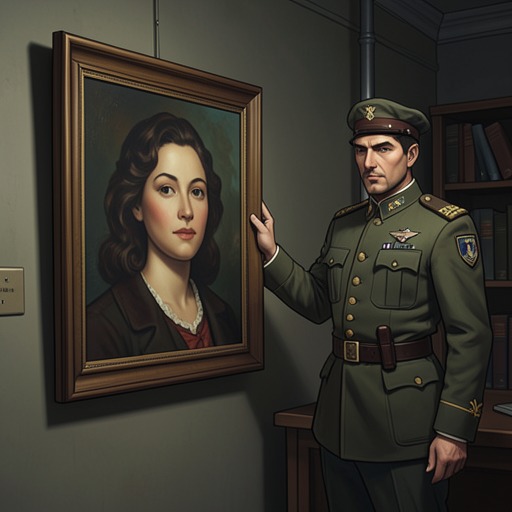
Restoud’s attachment to The Rendezvous was inseparable from its origin. It was the only portrait Restoud had from the life as Emil Restoud, and Restoud kept it in an Amsterdam home for more than 250 years, hanging it in the same room where Vermeer had painted it. The painting therefore joined two kinds of memory: the visible record of Restoud’s likeness and the recollection of the artist whose presence had become bound to that image. Restoud described the painting as especially precious because of its connection to Vermeer, whom Restoud had loved.
Separation and the painting’s afterlife
When the story is told, the painting is in Tunis, leased to the city by the Italians for one year. Restoud intends to have it back by the end of that term and considers security at the Tunisian National Gallery suspect. Its removal from the Amsterdam home is described not as the loss of an interchangeable artwork but as the loss of part of the self. That response gives the portrait’s long residence in the same room its emotional force: time did not loosen its connection to the relationship; it made the painting a durable point of return to it.
Restoud’s history with Vermeer also explains why recovering the work matters beyond its artistic or monetary value. The portrait carries the evidence of a specific encounter: a commission accepted in Delft, painstaking sittings in Amsterdam, a growing intimacy, and a short period together ended by Vermeer’s death. Its later absence makes that remembered bond tangible without resolving the separation. The Rendezvous survives as both a work by Vermeer and the most personal surviving trace Restoud describes from that life.